How to Spot Roof Storm Damage Fast

A storm does not need to tear half the roof off to cause trouble. In Surrey and Middlesex, a night of strong wind and heavy rain is often enough to loosen tiles, lift flashing or let water into places you will not see until the damage spreads. If you are wondering how to spot roof storm damage, the key is knowing what to check straight away and what signs tend to show up a few days later.
The biggest mistake property owners make is assuming that no obvious leak means no problem. Roof storm damage is often subtle at first. A single slipped tile, a hairline crack in a ridge, or a blocked gutter overflowing onto brickwork can all turn into a more expensive repair if left too long.
How to spot roof storm damage from ground level
Start with what you can see safely from outside. You do not need to climb onto the roof to notice the first warning signs, and in most cases you should not. After high winds or driving rain, stand back from the property and check the roofline from different angles.
Look for missing tiles or slates first. These are the most obvious signs, but not the only ones. Tiles may still be in place and yet have shifted enough to leave a gap. If one section of the roof looks uneven, slightly dipped or out of line with the rest, that is worth attention.
Ridge tiles and hip tiles also deserve a close look. Storms can loosen the mortar bedding or cause movement along the top of the roof. You may notice cracked mortar on the ground below, or a ridge line that looks less straight than it did before. That kind of movement can let in water long before a tile actually falls.
Check the guttering, fascias and soffits while you are there. Strong wind can pull gutter brackets loose or fill the gutters with debris washed down from the roof. If water cannot drain properly, it can back up under the edge of the roof covering. Overflow marks on the wall, sagging gutters or pieces of tile in the gutter run are all signs the storm has done more than make a mess.
If you have a flat roof, the signs can be different. Bubbling, lifting at the edges, splits in the surface or standing water that does not drain away after the rain has stopped can all point to storm-related damage. Flat roofs often suffer where seams, trims and outlets have been put under pressure.
Signs of storm damage inside the property
A roof problem does not always announce itself with water dripping into a room. Often the first indoor signs are smaller and easier to miss, especially in loft spaces and upper floors.
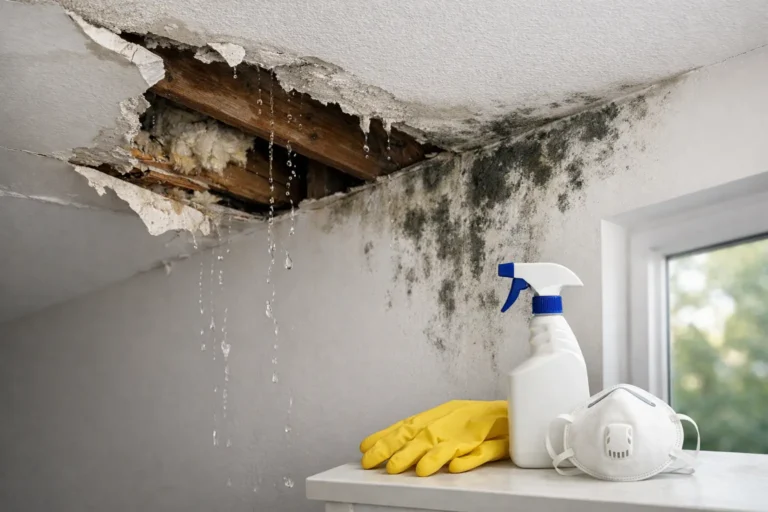
Start in the loft if you have one. Look for damp patches on timbers, dark staining on felt, wet insulation or daylight showing through where it should not. A musty smell after a storm can also be a clue that moisture has got in. Even if the leak seems minor, water can travel along rafters and show up away from the point of entry, so the stain on the ceiling is not always directly below the damaged area.
Upstairs bedrooms and landings can reveal problems too. Watch for fresh watermarks, peeling paint, blistered plaster or wallpaper lifting near the ceiling line. In some cases, you may only notice that a patch feels colder or damper than usual. That usually means the problem has been building for a little while.
With flat roofs over extensions, garages or commercial units, damp may appear around ceiling joints, corners and light fittings. If that happens after heavy weather, it is sensible to treat it as a roof issue until proven otherwise.
The storm damage people often miss
Some of the most common roof issues after bad weather are the ones householders do not notice until the repair becomes larger. Lead flashing around chimneys, abutments, dormers and roof windows can lift or crack under wind pressure. Because flashing sits tight to the roof, damage here is easy to overlook from the ground.
Chimneys are another weak point. A storm can loosen pointing, damage flaunching around the pots or dislodge chimney flashings. You might spot bits of mortar in the garden or driveway before you notice anything wrong with the stack itself.
There is also the issue of debris impact. Branches, broken fencing panels and airborne rubbish can crack tiles without knocking them off completely. From below, the roof may still look broadly intact, but a cracked tile can let in enough water to damage battens, felt and ceilings over time.
This is where it depends on the age and type of roof. Older tiled roofs may be more prone to slipped coverings and brittle mortar failure, while newer roofs can still suffer from lifted ridges, damaged membranes or drainage issues. Flat roofs can be perfectly serviceable for years, then one storm exposes a weak seam or outlet detail.
What to do straight after a storm
If you suspect damage, the first job is to stay safe. Do not get on ladders in wet or windy conditions, and do not walk on a roof unless you are trained and equipped to do it properly. Many injuries happen when people try to inspect storm damage too quickly.
Take clear photos from the ground if you can do so safely. Photograph any missing tiles, fallen debris, internal watermarks and anything else that looks out of place. That gives you a record of the condition and can help if the issue worsens or if you need to discuss repairs promptly.
If water is getting into the property, try to limit internal damage by moving furniture, putting containers under drips and protecting floors. With loft leaks, it may help to place a bucket in the affected area, but only if you can reach it safely and there is no electrical risk.
Then get the roof checked. Fast action matters because storm damage rarely stays in the same condition for long. Wind can turn one loose tile into several. Rain can turn a small hidden gap into rotten timbers, stained ceilings and damaged insulation.
How to spot roof storm damage before it becomes expensive
The simplest answer is this: compare what you see after the storm with what is normal for your property. If the roofline looks uneven, the gutters are overflowing, there is debris where there was none before, or the loft suddenly smells damp, do not wait for a major leak to confirm it.
It also helps to think beyond the roof covering itself. Storm damage can affect guttering, fascias, soffits, chimney work and even nearby fencing or trees that have struck the building. A proper inspection looks at the whole exterior because the issue is not always isolated to one tile or one patch of felt.
For landlords and small commercial property owners, speed is even more important. Tenants may report a leak only after internal damage becomes visible, and by that stage repair costs can climb. A post-storm check is a simple way to avoid disruption later.
If the roof is older, has had previous patch repairs, or has known weak points around chimneys, valleys or roof windows, it is wise to be more cautious. Storms tend to expose the areas already under strain. What held up through a normal week may not hold up through a night of heavy wind and rain.
When to call a roofer
Call sooner rather than later if you can see missing or slipped tiles, damaged flashing, movement in ridge tiles, debris impact, active leaks or overflowing guttering that is affecting the walls. The same applies if you are unsure. Uncertainty is not a reason to leave it. It is a reason to have it checked by someone who deals with storm damage regularly.
A good inspection should tell you whether the problem is minor and localised or whether there is wider damage to address. Sometimes it is a straightforward repair. Sometimes what looks small from below has affected underfelt, battens or surrounding roof sections. That is why guessing from the ground only gets you so far.
For local property owners, this is where using an experienced contractor makes the process simpler. AJW Specialists Property Maintenance handles roof repairs, exterior works and site clearance, which is useful when a storm has caused more than one problem at once.
After bad weather, trust what the property is telling you. A loose tile, a damp patch or a sagging gutter may not look urgent at first, but catching it early usually means a cleaner, quicker and less costly repair.