Can a Leaking Flat Roof Be Repaired?
A flat roof rarely starts with a dramatic collapse. More often, it begins with a damp patch on the ceiling, a drip near a wall, or water sitting on the roof longer than it should. So, can a leaking flat roof be repaired? In many cases, yes – but whether it should be repaired, patched temporarily, or replaced properly depends on what is causing the leak and how far the damage has already spread.
Flat roofs are often very repairable, especially when the problem is caught early. The trouble is that water does not always come through directly below the fault. It can track under the covering, soak insulation or decking, and show up somewhere else entirely. That is why a proper inspection matters more than a guess and a tube of sealant.
Can a leaking flat roof be repaired, or is replacement better?
There is no one-size-fits-all answer. A newer flat roof with one split, one failed joint or local storm damage may only need a targeted repair. An older roof with repeated leaks, soft decking, ponding water and widespread wear is often a different story. Repairing one spot on a roof that is failing in several places usually just delays the next callout.
The age of the roof is a big factor. If the covering is still within its expected service life and the structure underneath is sound, repair is often the sensible option. If the roof is nearing the end of its life, the better value may be a replacement rather than ongoing patch jobs.
This is where experience counts. A good roofer is not just looking for the visible leak. They are checking the condition of the felt, membrane or asphalt, the edges and upstands, flashing details, falls, outlets and the deck below. The goal is to find the real entry point and work out whether the defect is isolated or part of a bigger problem.
The most common reasons flat roofs leak
Flat roofs take a lot of punishment from standing water, UV exposure, frost, foot traffic and general ageing. The leak itself is usually just the end result.
One common issue is cracked or blistered felt. Over time, older felt systems can split as they expand and contract. Once that surface is broken, water can work its way underneath. Another regular problem is failed joints on felt or single-ply systems, particularly around corners, parapet walls and roof penetrations.
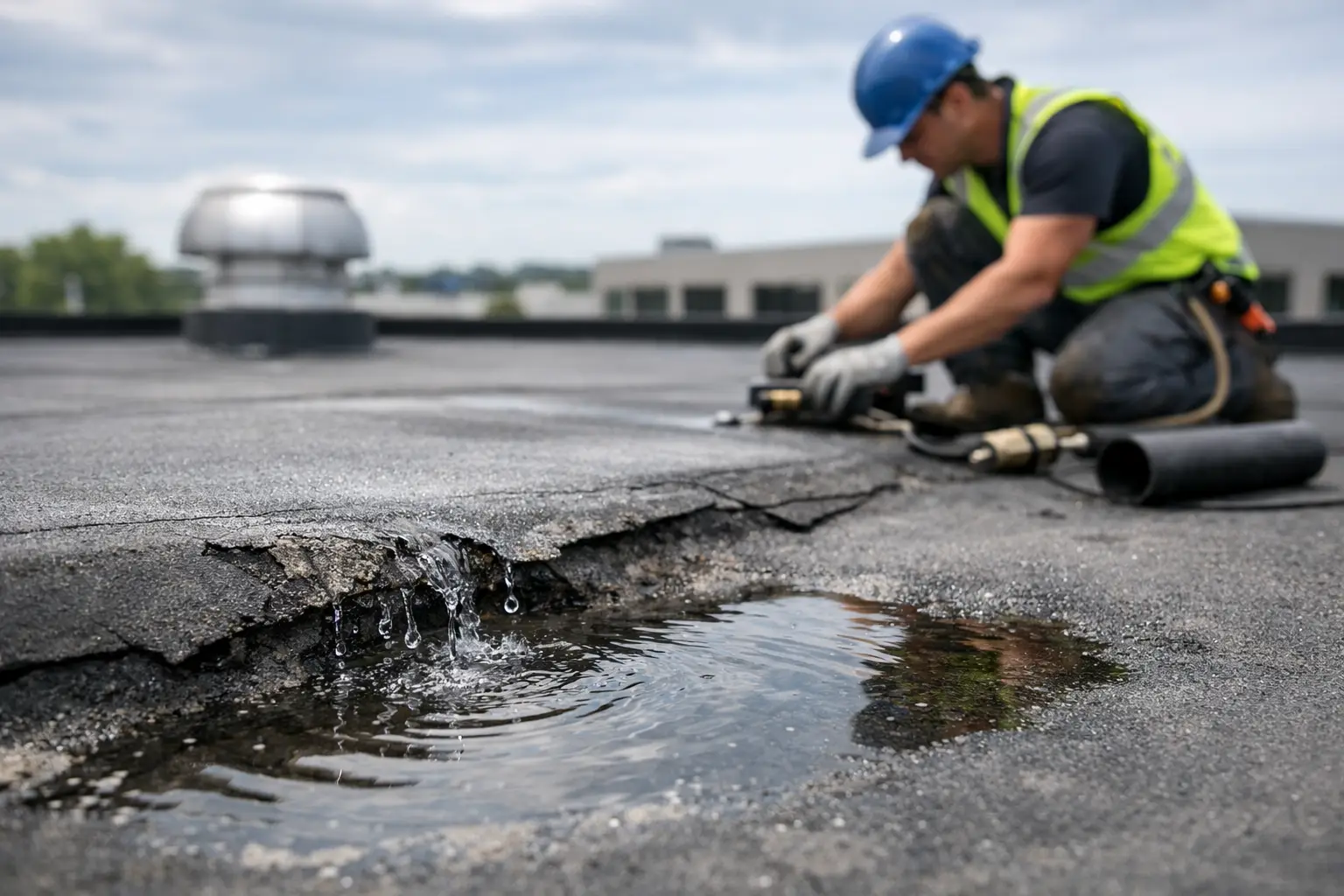
Poor drainage is another major cause. Despite the name, a flat roof should still have enough fall to move water towards an outlet. If water sits in the same area for long periods, it increases wear and exposes weak points. Blocked gutters, hoppers and outlets can make this worse very quickly.
Lead flashing and edge details also matter. A flat roof may leak not because the field of the roof has failed, but because the flashing has lifted or the perimeter detail has broken down. In some cases, the structure under the covering has deteriorated, especially if leaks have been left untreated for too long.
What a proper flat roof repair might involve
A real repair is not the same as smearing mastic over a damp surface and hoping for the best. The right method depends on the roof type and the actual defect.
On a felt roof, a repair may involve cutting out the damaged section and applying a new patch with proper bonding and sealed edges. If joints have failed, they may need to be lifted and re-bonded or overlaid. On GRP or fibreglass roofs, repairs can involve sanding back the failed area and rebuilding it with new matting and resin. On rubber roofs, the fix may be a specialist patch with compatible adhesive and edge treatment.
If the decking below is wet or rotten, the covering alone is not the whole job. The damaged substrate may need replacing before any new waterproof layer goes down. If the leak is coming from flashing, upstands or trims, that detail must be rebuilt correctly or the roof will keep letting water in.
A sound repair should leave the area watertight, secure and able to handle weather properly. It should also address why the leak happened in the first place, whether that is movement, age, trapped moisture or poor drainage.
When a repair is likely to work well
Repairs tend to be worthwhile when the roof is otherwise in fair condition and the issue is localised. That could mean a small puncture caused by debris, a split near an outlet, storm damage to one edge, or a joint failure around a skylight or vent.
It also helps if the leak has been picked up early. The sooner the fault is dealt with, the less chance there is of hidden water damage spreading into the insulation, timbers or ceilings below. In these cases, a repair can be quick, cost-effective and long lasting.
For landlords and property owners, this is often the best-case scenario. You fix the problem before it turns into internal repairs, tenant disruption or a much bigger roofing bill.
When a repair may only be a short-term fix
Sometimes a leak can be stopped, but that does not mean the roof is in good order. If the covering is brittle, there are multiple old repair patches, the edges are failing, or the deck feels soft underfoot, it is usually a sign that the roof has reached the point where repairs are becoming false economy.
Ponding is another warning sign. If the roof has poor falls and water consistently sits in large areas, local repairs may hold for a while but the underlying stress on the system remains. Likewise, if moisture is trapped beneath the covering, patching the top surface may not solve the full problem.
This is where an honest assessment matters. A dependable contractor should tell you plainly if a repair is sensible, if it will buy time, or if replacement is the more reliable route.
Should you try a DIY flat roof repair?
For most property owners, only very temporary measures are worth considering, and only if it is safe to do so. Clearing a blocked outlet or placing a bucket under an internal drip is one thing. Climbing onto a wet roof with sealant and no proper diagnosis is another.
DIY repairs often fail because the source of the leak has not been found correctly or the wrong materials have been used on the wrong roof type. Worse still, surface-applied products can trap moisture, hide defects and make a proper repair harder later on.
There is also the safety issue. Flat roofs can be slippery, edges are hazardous, and hidden weak spots are not always obvious. If water is getting in, the safest move is usually to have the roof inspected properly and get the issue dealt with before the damage spreads.
How quickly should a leaking flat roof be dealt with?
As quickly as possible. Even a small leak can do more damage than people expect. Water can affect plaster, electrics, insulation, timber joists and internal finishes long before the ceiling gives way or stains become severe.
The longer it is left, the more likely it is that a simple repair turns into replacement of boards, insulation and internal materials as well. Fast action usually saves money. It also reduces disruption, especially in occupied homes, rented property and small business premises.
If the leak follows heavy rain or storm conditions, it is worth treating it as urgent. Temporary weatherproofing may be needed first, followed by a full repair once the roof can be inspected safely and properly.
What to expect from a roofer inspecting a leaking flat roof
A proper inspection should be practical and straightforward. The roofer should look at the roof covering, joints, flashings, outlets, edges and any signs of standing water. They should also consider what is happening inside the property, because ceiling stains do not always line up with the fault above.
You should expect a clear explanation of the problem, the likely repair method, and whether the fix is local, temporary or part of a bigger issue. If replacement is recommended, there should be a reason for it beyond simply saying the roof is old.
For local property owners in Ashford, Staines and nearby parts of Surrey and Middlesex, that direct approach matters. When a roof is leaking, most people do not want sales talk. They want someone to turn up, find the fault, explain the options clearly and do the job properly.
A leaking flat roof can often be repaired, and in many cases it should be. The key is catching it early, diagnosing it properly and choosing a fix that matches the roof’s actual condition rather than just covering over the symptoms. If you are seeing signs of water coming in, the best next step is simple – get it checked before a small leak turns into a much bigger repair.