7 Best Fence Styles for Privacy
If your garden backs onto a pavement, a neighbour’s drive or a busy road, privacy stops being a nice extra and becomes the whole point of the job. Choosing the best fence styles for privacy is not just about picking the tallest panel in the yard. You need something that blocks sightlines properly, stands up to weather, suits the property and does not become a maintenance problem two winters later.
A lot of fencing looks good on day one and disappoints once it is exposed to wind, rain and daily use. That is why it pays to think beyond appearance. The right fence should give you screening, security and a clean finish, while still making sense for your budget and the layout of the garden.
What makes a privacy fence work well?
A proper privacy fence needs more than height. Gaps between boards, ground levels, panel movement and weak posts can all reduce the cover you thought you were getting. A fence can be 6ft high on paper and still leave clear views into the garden if there are spaces underneath or if the design is too open.
The most effective options usually have solid or near-solid construction, minimal shrinkage gaps and a strong frame. In exposed parts of Surrey and Middlesex, wind load matters as much as screening. A very solid fence catches more wind, so the style, post choice and installation method all need to work together.
Best fence styles for privacy in UK gardens
Closeboard fencing
Closeboard fencing is one of the most reliable choices for privacy. It uses overlapping vertical boards fixed closely together, creating a strong and fairly solid barrier. For many homes, this is the practical benchmark because it offers good screening, strong durability and a straightforward appearance that suits most properties.
It also handles rough weather better than many lightweight panel systems. If you have a long boundary or a garden that takes the full force of wind, closeboard often makes more sense than decorative alternatives. The trade-off is that it is more functional than stylish unless you improve the finish with good posts, gravel boards and careful staining or painting.
Feather edge fencing
Feather edge is closely related to closeboard and often the better option where boundaries are uneven or awkward. The boards are fixed on site rather than bought as one rigid panel, which gives more flexibility around sloping ground and varying lengths.
For homeowners who want strong privacy without the limits of off-the-shelf panels, feather edge is hard to beat. It can be built to a very tidy standard and repaired in sections if damage occurs. That matters if you would rather replace a few boards than an entire run.
Tongue and groove fence panels
If appearance matters as much as screening, tongue and groove panels are worth a serious look. The boards interlock, which creates a cleaner, more premium finish than overlap panels and usually gives better privacy because there are fewer visible gaps.
This style works well in modern gardens, courtyards and smaller spaces where every detail is more noticeable. It tends to cost more than standard overlap fencing, but the result is neater and often quieter in windy conditions because the boards fit together more tightly. The main thing to watch is quality. Cheap tongue and groove panels can swell, warp or fail early if the timber is poor.
Hit and miss fencing with screening in mind
Hit and miss fencing is not the first style most people think of for privacy, because the boards are arranged with deliberate spacing. On its own, it is better for airflow than complete screening. That said, it can still be useful in gardens where you want partial privacy without creating a heavy, boxed-in feel.
It is often a sensible choice in very exposed locations because wind passes through more easily. If full privacy is your priority, this would not rank at the top. If you want a balance between shelter, durability and a softer look, it can work well along certain boundaries, especially when combined with planting.
Slatted fencing
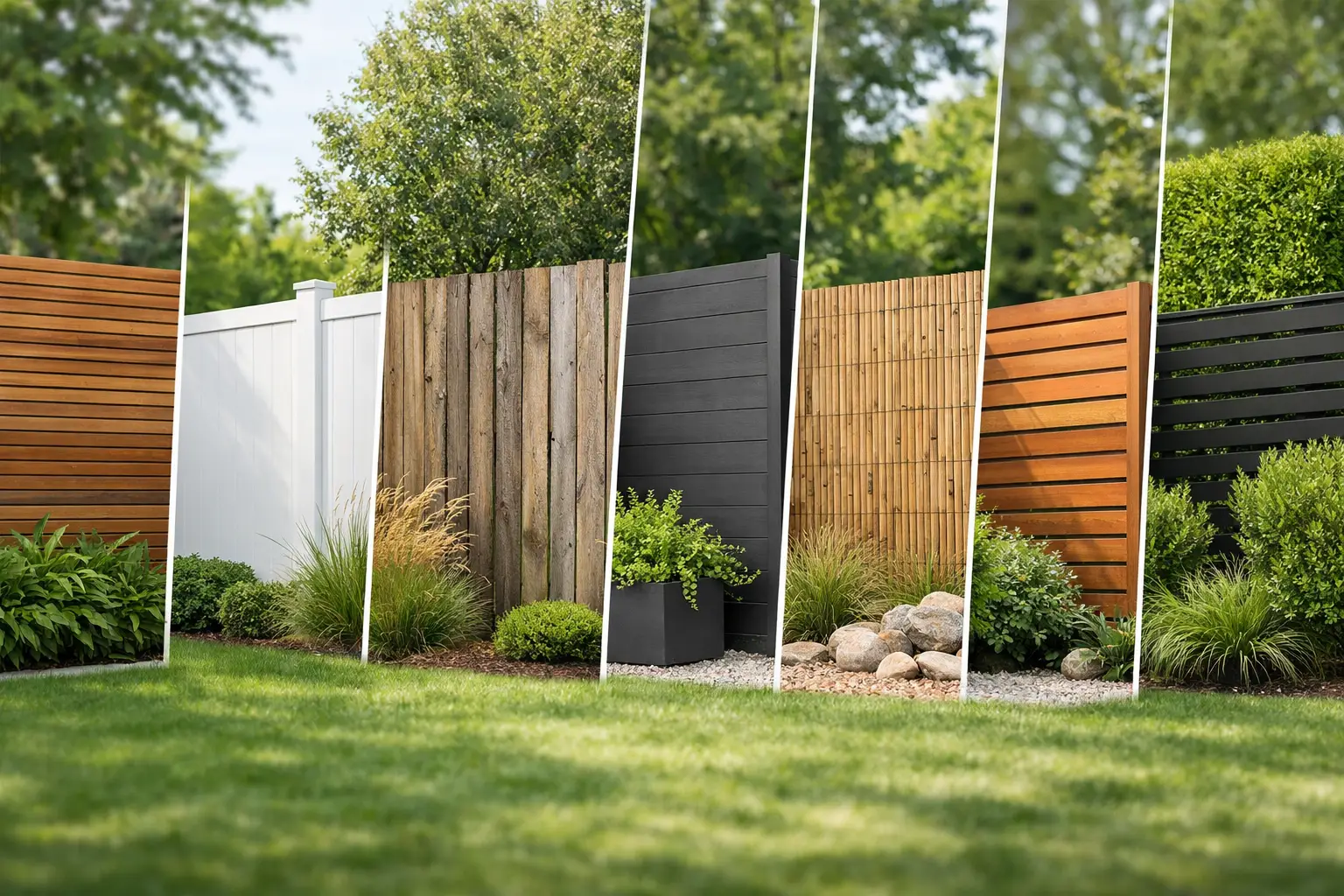
Slatted fencing has become popular on newer properties and landscaped gardens. Done properly, it gives a smart, contemporary finish and can screen a space without making it feel closed off. Horizontal slats are the usual choice, although vertical slats are also used for a cleaner architectural look.
The key phrase here is done properly. Slatted fencing can offer good privacy if the spacing is tight and the angles are right, but some versions are more about style than screening. From outside, they may look private enough, but from a patio or raised garden next door, sightlines can still get through. It is a good option if you want a modern finish, but it needs careful design rather than guesswork.
Composite fencing
Composite fencing is one of the lowest-maintenance privacy options available. It usually combines recycled materials with a solid board system that resists rot, insect damage and a lot of the upkeep associated with timber. For busy homeowners or landlords, that low-maintenance appeal is a major advantage.
It also gives a very consistent finish, which suits modern homes and rental properties where you want tidy boundaries without regular treatment. The drawback is cost. Composite usually comes in higher than standard timber, and some cheaper systems can look artificial up close. Still, if your priority is privacy with minimal ongoing work, it is one of the stronger long-term options.
Acoustic or heavy-duty solid panels
Where gardens back onto roads, schools or commercial premises, standard privacy fencing may not feel like enough. Heavier solid panel systems, and in some cases acoustic-style fencing, can help create a more enclosed and sheltered boundary.
This type of fencing is not needed for every home, but it makes sense where noise and privacy are linked. You are generally paying more for stronger construction and better performance, so it is best suited to problem boundaries rather than every side of the garden.
Choosing the right style for your property
The best fence styles for privacy depend on what is happening around the boundary. A family garden overlooked from upstairs windows needs a different approach from a side return next to a public footpath. Height is part of the answer, but layout matters just as much.
If the ground slopes, built-on-site feather edge often gives a better result than rigid panels. If the garden is very exposed, a fully solid fence needs proper posts and secure installation or it can fail under pressure. If you want a smarter finish near the house but a more cost-effective solution down the side boundary, mixing styles may be the sensible option.
Budget matters too, but it is worth being realistic about where the money goes. Cheap fencing often means thinner timber, lighter framing and shorter lifespan. Paying for stronger posts, treated timber and correct fitting usually saves money compared with repairing storm damage or replacing failed sections early.
Timber, concrete or composite posts?
Posts are easy to overlook, but they do a lot of the hard work. Timber posts can look more natural, though they are often the first part to weaken over time if water gets in. Concrete posts are tougher and usually last longer, especially on exposed boundaries or where previous fencing has failed at the post line.
Composite systems often use aluminium or reinforced supports depending on the manufacturer. They can be a good long-term choice, but the full system needs to be installed properly. There is no point paying for premium boards if the framework underneath is not up to the job.
Privacy without making the garden feel smaller
One concern homeowners often have is that a privacy fence will make the garden feel shut in. That can happen, especially with dark, heavy fencing around a small space. The answer is not always to choose a more open style. Often it is about colour, layout and where solid screening is actually needed.
A fence can be fully private and still look clean and attractive if the finish is right. Lighter stains, well-spaced planting and consistent panel lines can stop the boundary from feeling oppressive. In some gardens, using stronger screening only where you are overlooked most can give a better result than enclosing the entire plot in the same heavy style.
When it is worth getting advice before you buy
Fencing is one of those jobs that looks simple until you start dealing with rotten posts, awkward levels and shared boundaries. If you are replacing a damaged run or upgrading for privacy, it helps to get advice on what will actually suit the site rather than just what is cheapest in the merchant’s yard.
A dependable contractor will look at wind exposure, access, drainage, post choice and the condition of the ground before recommending a style. That is especially useful if the old fence has already failed once. AJW Specialists Property Maintenance handles fencing as part of wider exterior works, so customers who also need clearance, landscaping or repairs can get the whole job sorted properly rather than piecing it together with different trades.
The right privacy fence should make life easier, not create another maintenance headache. If you choose a style that suits the property, the weather exposure and the level of screening you actually need, you will feel the benefit every time you step into the garden.